
Understanding Medical Negligence in India: Insights from Jacob Mathew vs. State of Punjab
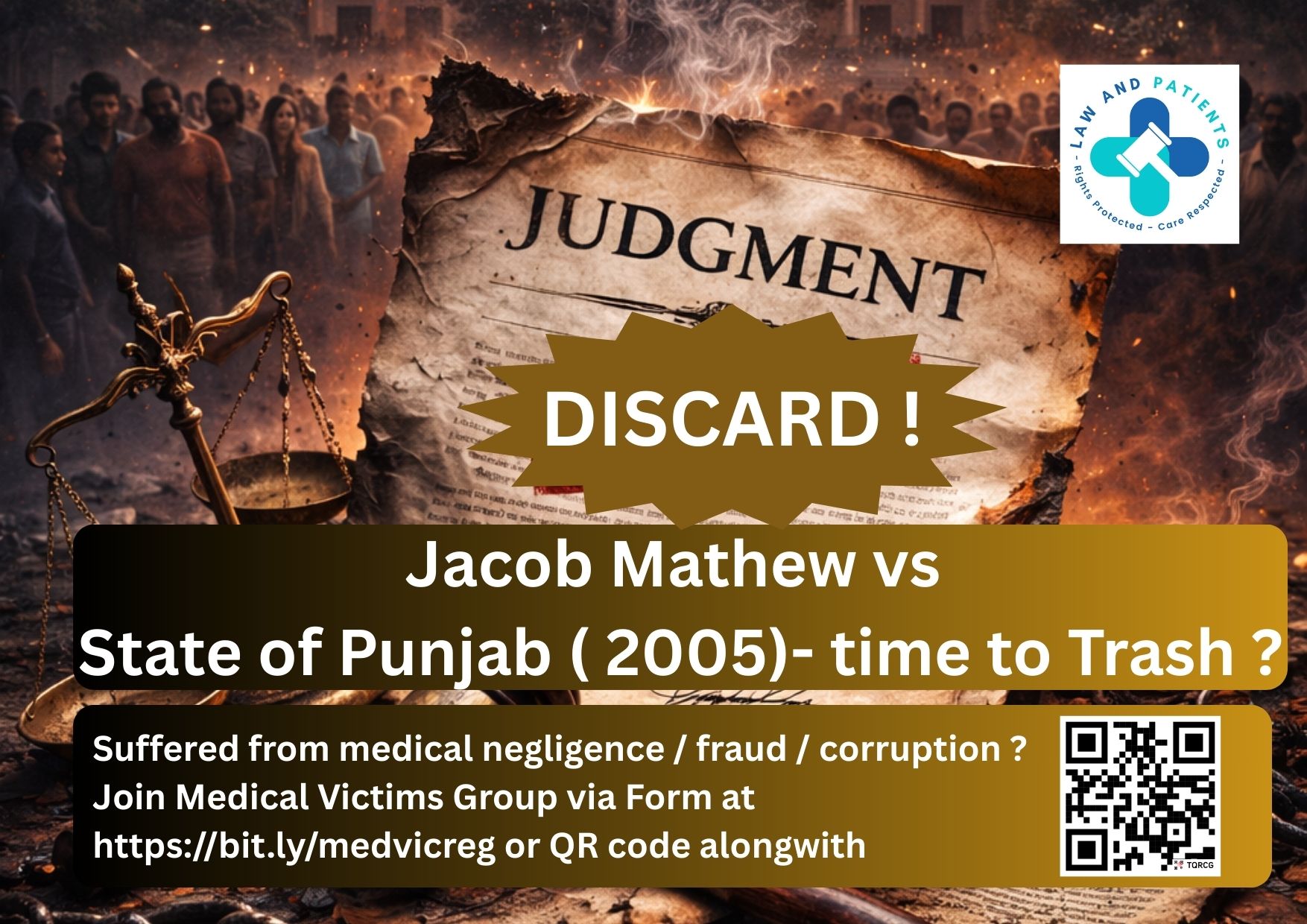
Medical negligence is a sensitive and often complex area of law in India, where the rights of patients and the responsibilities of healthcare professionals intersect. The legal standards governing these disputes are shaped significantly by judicial decisions. An absolute Landmark Case here is the Hon’ble Supreme Curt’s judgement in Jacob Mathew vs. State of Punjab (2005).
We have kept here the full Judgement which can be downloaded from this link.
What Is Medical Negligence?
In general terms, medical negligence arises when a healthcare provider fails to exercise the level of care that a competent professional would reasonably provide under similar circumstances, and that failure leads to harm. However, not every unfortunate outcome or treatment error amounts to actionable negligence — especially under criminal law. This is the basic thrust of Medical Jurisprudence, and is brought out clearly in many cases, most prominently in the Jacob Mathew case.
The Jacob Mathew Case: A Landmark Decision
Background of the Case
In the mid-1990s, a patient suffering from advanced cancer was admitted to a hospital in Ludhiana. During a sudden medical emergency, the doctor on call was alleged not to have provided timely assistance. An oxygen cylinder available in the room was discovered to be empty. The patient ultimately died.
Based on this, a criminal charge under Section 304A of the Indian Penal Code ( replaced effective July 1, 2024 by section 106 of the Bhartiyay Nyay Sanhita ) was framed against the treating doctor, leading to prosecutions at various levels of the justice system. After being dismissed by the trial and High Courts, the matter reached the Supreme Court.
Key Legal Principles from the Supreme Court
The Supreme Court quashed the criminal prosecution, not because negligence was impossible, but because the evidence did not legally demonstrate criminal negligence. The decision laid down several guidelines that have governed how similar cases are handled since.
1. High Threshold for Criminal Liability
Under Indian criminal law, a doctor cannot be prosecuted for every error that results in injury or death. The Supreme Court clarified that ordinary mistakes in judgment or routine lapses — without a showing of gross negligence or reckless disregard — are not sufficient for establishing criminal responsibility.
2. Expert Assessment Is Essential
Before a criminal prosecution may proceed, the court held that there must be credible expert medical evidence indicating that the doctor’s conduct fell significantly below accepted standards. This should ideally come from an independent, qualified medical professional — preferably a government doctor/panel of such doctors — to avoid bias.
This requirement serves two purposes:
- It filters out unfounded or trivial complaints.
- It helps the court focus on cases where professional standards were clearly breached.
3. Protection Against Routine Arrests
Another important principle is that doctors should not be routinely arrested merely because an allegation is made. Arrests should only take place if truly necessary — for example, to prevent evidence tampering or if there are genuine concerns about the doctor avoiding prosecution.
Broader Legal and Practical Impact
The Jacob Mathew judgement influences both criminal and civil aspects of medical negligence:
Criminal Law Context
- It set a protective threshold to prevent harassment of medical professionals for every adverse outcome.
- Police and courts now anticipate expert evaluation before moving forward with prosecution.
Civil / Tort / Consumer Claims
While Jacob Mathew primarily dealt with criminal liability, its reasoning affects civil disputes too. In civil cases, negligence may be established even without proof of gross misconduct — but must still meet the legal test of deviation from accepted medical standards. And increasingly, even consumer courts are relying upon the Jacob Matthew Judgement’s standards to establish whether a consumer case holds.
Why This Matters
The ruling attempts to strike a balance between two important objectives:
- Protecting patients’ rights to justice when real negligence occurs.
- Shielding healthcare providers from frivolous or vindictive legal actions that stem from outcomes beyond their control.
That said, critics argue that these legal safeguards sometimes make it harder for genuine negligence claims to be pursued effectively, especially where access to unbiased expert opinions is limited.
Conclusion
The Jacob Mathew judgement remains a cornerstone of Indian medical jurisprudence. It underscores that:
- Not every unfavorable medical result constitutes actionable negligence.
- Criminal liability requires clear, expert-backed evidence of gross deviation from standard practice.
- Doctors should not be unduly dragged into courts for ordinary professional challenges.
Understanding these principles is critical for both patients seeking legal recourse and practitioners navigating legal exposure in complex healthcare settings.
The most salient extract from the Judgement :
“Statutory Rules of Executive Instructions incorporating certain guidelines need to be framed and issued by the Government of India and/or the State Governments in consultation with the Medical Council of India. So long as it is not done, we propose to lay down certain guidelines for the future, which should govern the prosecution of doctors for offences of which criminal rashness or criminal negligence is an ingredient.
- A private complaint may not be entertained unless the complainant has produced prima facie evidence before the court in the form of a credible opinion given by another competent doctor to support the charge of rashness or negligence on the part of the accused doctor.
- The investigating officer should before proceeding against the doctor accused of rash or negligent act or omission, obtain an independent and competent medical opinion preferably from a doctor in Government service qualified in that branch of medical practice who can normally be expected to give an impartial and unbiased opinion in regard to the facts collected in the investigation.
- A doctor accused of rashness or negligence may not be arrested in a routine manner simply because a charge has been leveled against him unless his arrest is necessary for furthering the investigation or for collecting evidence or unless the investigation officer feels satisfied that the doctor proceeded against would not make himself available to face the prosecution unless arrested.”
Some ground realities
The intent behind these instructions is noble – no doctor should be penalized for trying to save/ cure a patient. As has been said in the judgement ” “If the hands be trembling with the dangling fear of facing a criminal prosecution in the event of failure for whatever reason… neither can a surgeon successfully wield his life-saving scalpel… nor can a physician successfully administer the life-saving dose of medicine” .
However, over time – and with profit motives overshadowing all aspects of the erstwhile noble medical profession- the Judgement raises many difficulties even in cases of genuine medical negligence which could sometimes be outright fraud or corruption. This, compounded with the inherent peculiarities of the medical profession that set it apart from another criminal, makes delivering timely justice for a wronged patient/ family extremely difficult, if not impossible.
In another post we shall elaborate on these difficulties.
If you are a sufferer of medical negligence. fraud or corruption and pursuing legal recourses, you are invited to join the Medical Victims Whatsapp Group to interact with others similarly placed in order to learn from each other’s experiences, raise a joint voice, as well as get prima facie legal inputs. For the same, fill form via link https://bit.ly/medvicreg or via QR Code hereunder.

You will be contacted thereafter.
Perfect example of medical negligence.